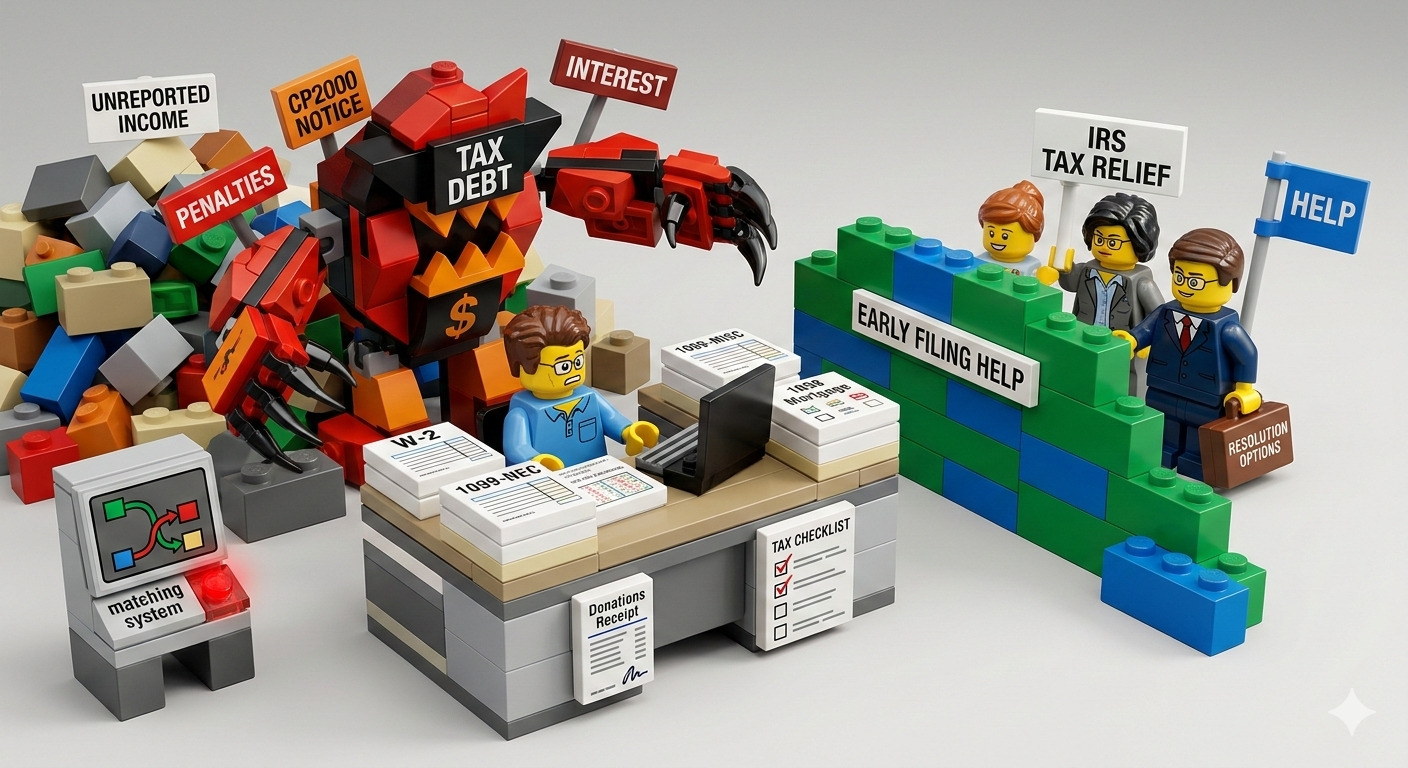
Filing Without the Right Documents Is One of the Fastest Ways to Create Tax Debt
Every year, thousands of taxpayers across the United States receive unexpected IRS notices — not because they intended to underreport income, but because they missed a form.
The IRS receives copies of most income documents issued under your Social Security number or EIN. When your tax return doesn’t match what the IRS already has on file, the system automatically generates a discrepancy notice. That notice often proposes additional taxes, penalties, and interest.
In many cases, what starts as a simple oversight becomes a growing tax debt problem that requires professional IRS tax relief.
The good news? Most of these problems are completely preventable.
This comprehensive tax document checklist will help you file accurately, avoid penalties, and reduce your risk of IRS enforcement actions.
If you are already behind or unsure whether your filing is complete, do not wait — early tax debt help preserves more resolution options.
Why Missing One Tax Form Can Trigger IRS Action
The IRS operates a powerful document-matching system. It compares what third parties report about your income against what you report on your return.
That includes:
- Employers (W-2)
- Clients (1099-NEC)
- Banks (1099-INT)
- Investment firms (1099-DIV, 1099-B)
- Retirement custodians (1099-R)
- Payment processors (1099-K)
- Cryptocurrency exchanges
- Marketplace insurance providers
- Social Security Administration
If even one form is omitted, the IRS may issue a CP2000 notice proposing additional tax. The notice often includes:
- Additional tax due
- Accuracy-related penalties
- Failure-to-pay penalties
- Daily compounding interest
Many taxpayers ignore the first letter, assuming it’s minor. Months later, the balance has grown significantly, and enforcement action becomes possible.
Preventing that outcome starts with complete documentation.
Complete Tax Document Checklist for Individuals
Before filing, gather every applicable document from the categories below.
1. Wage and Employment Income
- W-2 forms from all employers
- 1099-NEC for contract work
- 1099-MISC (if applicable)
- Tip income records
- Union benefit statements
Even short-term or part-time jobs must be included. Employers report all wages to the IRS.
2. Self-Employment and Side Income
This is where many discrepancies occur.
Collect:
- 1099-NEC forms from all clients
- 1099-K from payment platforms
- Direct deposit summaries
- Cash income records
- Invoices issued
- Profit and loss statements
Gig workers, consultants, freelancers, and online sellers face elevated audit risk due to income mismatches. If you are self-employed, documentation must be thorough.
Failure to properly report self-employment income is one of the leading causes of tax debt nationwide.
3. Investment and Passive Income
Investors frequently miss supplemental statements.
Gather:
- 1099-INT (interest)
- 1099-DIV (dividends)
- 1099-B (stock sales)
- Cryptocurrency transaction summaries
- K-1 forms from partnerships or S-Corps
- Rental income statements
Brokerage 1099s often arrive later than W-2s. Filing before all forms are received can create discrepancies.
4. Retirement and Government Benefits
Include:
- 1099-R (IRA, 401(k), pension distributions)
- SSA-1099 (Social Security)
- Unemployment compensation statements
- State tax refunds
IRS systems heavily monitor retirement distributions.
5. Deduction Documentation
Deductions reduce tax liability — but only if properly documented.
Gather:
- Mortgage interest statement (Form 1098)
- Property tax bills
- Charitable donation receipts
- Medical expense summaries
- Education expense forms (1098-T)
- Childcare provider EIN and payment totals
- Energy credit documentation
Unsupported deductions frequently trigger audits.
6. Business Expense Records (If Applicable)
If you operate a business, also collect:
- Bank statements
- Credit card summaries
- Mileage logs
- Equipment purchase receipts
- Payroll filings
- Estimated tax payment confirmations
- Prior-year depreciation schedules
Self-employed taxpayers are disproportionately targeted in audits and enforcement actions due to incomplete recordkeeping.
The Hidden Risk of Filing Too Quickly
Many taxpayers rush to file early to “get it done.” That decision often backfires.
Common problems from early filing include:
- Missing late-arriving 1099 forms
- Incomplete brokerage statements
- Absent K-1s from pass-through entities
- Forgotten side income
- Overlooked digital payment platform reports
If additional income documents arrive after filing, you may need to amend your return. Failure to amend increases the likelihood of IRS adjustments and tax debt assessments.
What If You Already Filed and Forgot Something?
If you realize you omitted income:
- File an amended return immediately.
- Pay additional tax as soon as possible.
- Monitor IRS transcripts to confirm processing.
Waiting for the IRS to detect the error almost always results in higher penalties.
If you have already received a CP2000 or similar notice, it may be time to explore professional IRS tax relief options.
The earlier you respond, the more leverage you maintain.
How Missing Documents Turn Into Tax Debt
When discrepancies span multiple years, the situation escalates.
The IRS may:
- Assess additional taxes automatically
- Add accuracy penalties
- File federal tax liens
- Levy bank accounts
- Garnish wages
- Offset future refunds
At this stage, you are no longer simply correcting paperwork. You are pursuing structured tax debt help.
Small documentation mistakes, when repeated, compound into serious financial consequences.
How to Build a Documentation System That Protects You
Prevention requires organization.
Consider implementing:
- A dedicated digital tax folder for each year
- Immediate scanning of mailed documents
- A running spreadsheet of income sources
- Quarterly income reconciliation
- Annual transcript reviews
For business owners, monthly bookkeeping is not optional — it is protection against enforcement.
When You Should Seek Professional Review
You should schedule a professional tax review if:
- You have multiple income streams
- You receive K-1s or partnership distributions
- You trade stocks or cryptocurrency frequently
- You operate a side business
- You received an IRS notice
- You suspect past underreporting
Tax problems rarely improve on their own. They escalate quietly until enforcement begins.
Frequently Asked Questions
What happens if I forget a 1099?
The IRS will likely issue a notice proposing additional tax. Penalties and interest will apply unless corrected quickly.
How long does the IRS have to audit?
Generally three years, but longer if substantial income is omitted.
Should I amend before the IRS contacts me?
Yes. Proactive correction reduces penalties and improves outcomes.
Can missing documents lead to criminal charges?
Most cases are civil. However, intentional concealment can escalate. Early correction matters.
The Cost of Waiting
If you are unsure whether your return was complete, waiting only increases the risk.
Penalties grow monthly. Interest compounds daily. IRS enforcement tools become available over time.
The difference between a manageable correction and a serious tax debt case often comes down to timing.
Don’t Let a Missing Form Turn Into a Tax Debt Crisis
If you are:
- Unsure whether all income was reported
- Behind on filing
- Facing an IRS discrepancy notice
- Worried about growing balances
Now is the time to act.
IRS tax relief options are strongest before enforcement begins.
Tax debt help is most effective when penalties are still manageable.
Every month you delay increases the total cost.
Schedule a confidential consultation today. Protect yourself before a documentation mistake turns into a long-term IRS problem.
