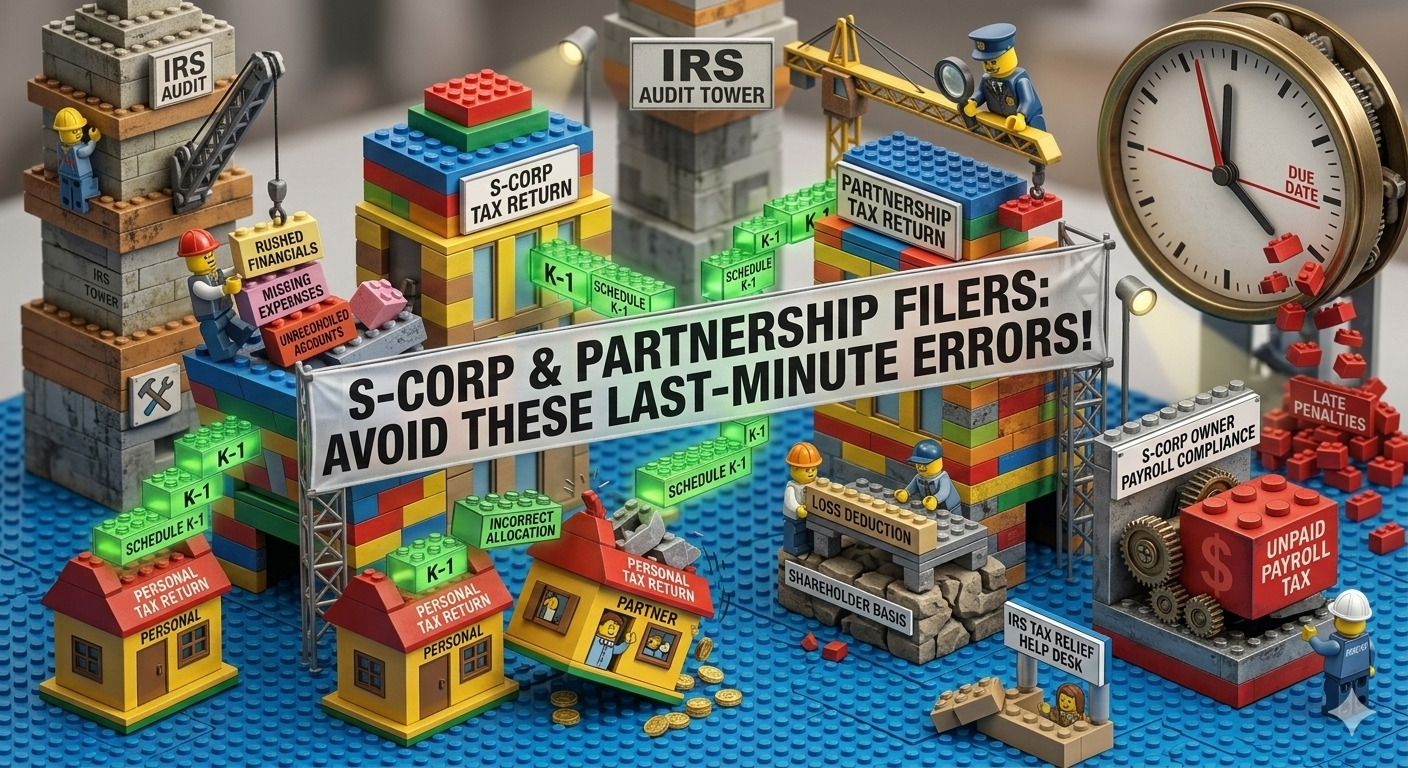
Business Entity Tax Filings Carry Higher Stakes Than Most Owners Realize
If you operate as an S-Corporation or partnership, your tax return is more than a formality — it is the foundation for your personal tax reporting, shareholder compliance, and IRS scrutiny.
Unlike individual returns, S-Corp and partnership filings generate pass-through documentation (Schedule K-1) that flows directly to owners’ personal returns. When mistakes occur at the entity level, they create a ripple effect that can trigger audits, penalties, amended returns, and in serious cases, escalating tax debt.
Across the United States, S-Corp and partnership filers face increased IRS oversight due to complex reporting requirements and high error rates. Even small last-minute mistakes can result in:
- Late filing penalties
- Incorrect income allocations
- Payroll compliance issues
- Shareholder basis problems
- IRS notices months after filing
If not addressed promptly, these errors can lead to substantial tax debt and require structured IRS tax relief.
Below are the most common last-minute errors S-Corp and partnership filers make — and how to avoid turning a filing oversight into a costly IRS problem.
Why S-Corp and Partnership Returns Receive Heightened Scrutiny
Pass-through entities do not pay federal income tax at the corporate level (with limited exceptions). Instead, income, deductions, credits, and distributions pass through to shareholders or partners.
This structure creates two levels of risk:
- The entity return must be accurate.
- The individual owner’s return must match the K-1 exactly.
The IRS cross-matches these filings. If discrepancies appear, notices are generated automatically.
Inaccurate entity returns are a leading cause of audit adjustments among small and mid-sized businesses nationwide.
Last-Minute Error #1: Filing Without Finalized Financials
Rushing the Books Before the Deadline
Many business owners scramble in the final weeks before the filing deadline. Incomplete bookkeeping leads to:
- Missing income deposits
- Unrecorded expenses
- Misclassified transactions
- Unreconciled bank accounts
When financials are not fully reconciled, the tax return becomes a guess — and guesses create discrepancies.
How This Becomes a Tax Debt Issue
If income is underreported or expenses are overstated:
- The IRS may assess additional tax
- Accuracy penalties (often 20%) may apply
- Interest compounds from the original due date
When multiple years contain errors, cumulative liability can grow rapidly, requiring professional help with tax debt.
Prevention Strategy
- Reconcile bank and credit card accounts monthly
- Finalize year-end books before tax preparation begins
- Avoid filing simply to “meet the deadline” without verification
If your entity return was filed using incomplete books, now is the time for review — before the IRS flags it.
Last-Minute Error #2: Incorrect or Missing K-1 Allocations
Why K-1 Accuracy Is Critical
Schedule K-1s report each owner’s share of:
- Ordinary business income
- Guaranteed payments
- Separately stated deductions
- Credits
- Distributions
If allocations are incorrect or inconsistent with the operating agreement, problems arise.
Common issues include:
- Allocating profits unevenly without documentation
- Failing to report guaranteed payments properly
- Mismatches between entity totals and distributed K-1s
The Domino Effect
If a partner files their personal return based on an incorrect K-1, and the entity later amends the return, that partner must also amend their individual return.
This creates confusion, delays refunds, and may result in penalties.
Repeated mismatches often attract audit attention.
Prevention Strategy
- Review operating agreements before allocating income
- Double-check that total K-1 allocations reconcile to entity totals
- Avoid issuing preliminary K-1s without clear communication
If you suspect your K-1 was incorrect, immediate review is essential before it escalates into a broader compliance issue.
Last-Minute Error #3: Shareholder Basis Miscalculations (S-Corps)
Basis Is Not Optional — It Determines Deductibility
For S-Corp shareholders, the basis determines:
- Whether losses are deductible
- Whether distributions are taxable
- Whether gains are recognized
Common mistakes include:
- Failing to track prior-year basis adjustments
- Ignoring the loan basis
- Overlooking distributions exceeding the basis
- Claiming losses without a sufficient basis
The IRS frequently examines basis calculations during audits.
Why This Leads to IRS Notices
If losses are claimed without basis support:
- The IRS disallows the deduction
- Tax liability increases
- Penalties and interest apply
Basis errors often span multiple years, compounding the issue.
Prevention Strategy
- Maintain annual basis schedules
- Track shareholder loans separately
- Review prior-year returns before filing
If you have claimed losses in prior years without documented basis calculations, proactive correction may prevent serious tax debt exposure.
Last-Minute Error #4: Payroll Compliance Failures (S-Corp Owners)
The Reasonable Compensation Rule
S-Corp shareholders who actively participate in the business must receive reasonable compensation, subject to payroll taxes.
Common violations include:
- Taking distributions but no salary
- Paying minimal wages is inconsistent with the role
- Failing to file payroll tax forms
- Late payroll tax deposits
The IRS aggressively enforces payroll compliance because payroll taxes are considered trust fund taxes.
Why Payroll Errors Escalate Quickly
Unpaid payroll taxes may result in:
- Trust Fund Recovery Penalties
- Personal liability assessments
- Aggressive collection actions
Payroll-related tax debt often escalates faster than income tax debt.
Prevention Strategy
- Establish reasonable salary benchmarks
- File payroll forms quarterly
- Deposit payroll taxes timely
- Maintain payroll documentation
If payroll compliance has been inconsistent, immediate corrective action is critical. Payroll tax issues are among the most serious IRS enforcement triggers.
Last-Minute Error #5: Missing the Filing Deadline
Entity Deadlines Come Earlier Than Many Expect
S-Corp and partnership returns are typically due earlier in the year than individual returns.
Failure to file on time may result in:
- Per-partner or per-shareholder penalties
- Accruing late filing fees
- Compounded multi-owner penalties
For entities with multiple owners, penalties multiply quickly.
Why Late Filing Is Expensive
Penalties are assessed per owner, per month. Even small partnerships can accumulate thousands of dollars in penalties in a short period.
Late filing also delays K-1 issuance, causing owners to file personal extensions and increasing compliance complexity.
Prevention Strategy
- Calendar entity deadlines well in advance
- File extensions proactively if books are incomplete
- Avoid ignoring filing obligations entirely
If your entity has unfiled returns, addressing them immediately is essential to avoid further escalation.
What Happens If the IRS Flags Your Entity Return?
If discrepancies are identified, the IRS may:
- Issue adjustment notices
- Initiate correspondence audits
- Expand review into prior years
- Assess penalties and interest
- Escalate to field audits for serious discrepancies
Once enforcement begins, resolution options become narrower.
This is when many business owners seek IRS tax relief — often after penalties have already accumulated.
Early review prevents reactive crisis management.
Multi-Year Errors: The Hidden Risk
Many entity-level issues repeat annually:
- Incorrect allocations
- Basis miscalculations
- Payroll noncompliance
- Underreported income
When errors span multiple years, total liability can grow rapidly.
The longer these issues persist, the more likely the IRS is to initiate a comprehensive review.
Structured tax debt help becomes more complex when multiple years are involved.
When You Should Seek Immediate Professional Review
You should schedule a compliance review if:
- Your books were finalized at the last minute
- You issued amended K-1s in prior years
- You have not tracked the shareholder basis
- Payroll compliance has been inconsistent
- Your entity has received an IRS notice
- You have unfiled entity returns
Early intervention preserves flexibility and reduces total cost.
Frequently Asked Questions
Can S-Corp owners avoid paying payroll taxes entirely?
No. Active shareholders must receive reasonable compensation subject to payroll taxes.
What happens if a K-1 is incorrect?
Both the entity and the individual owner may need to amend returns.
Are partnership penalties per entity or per partner?
Penalties are typically assessed per partner, per month.
Can basis errors trigger audits?
Yes. Basis is frequently examined in S-Corp audits.
The Cost of Waiting
Entity-level errors rarely resolve themselves.
Penalties grow monthly. Interest compounds daily. Multi-owner penalties multiply quickly.
What starts as a bookkeeping oversight can evolve into significant tax debt requiring structured IRS tax relief strategies.
The earlier you act, the more options remain available.
Protect Your Business Before Filing Mistakes Become Enforcement Problems
If you operate an S-Corp or partnership and:
- Filed under deadline pressure
- Suspect allocation or basis errors
- Have payroll compliance concerns
- Received an IRS notice
- Have unfiled entity returns
Do not wait.
Business tax problems escalate faster than individual filing mistakes — and they often affect multiple owners.
IRS tax relief is far more effective before enforcement actions begin.
Tax debt help is more manageable before penalties multiply.
Schedule a confidential consultation today to review your entity’s compliance and protect your business before minor filing errors become serious IRS issues.

