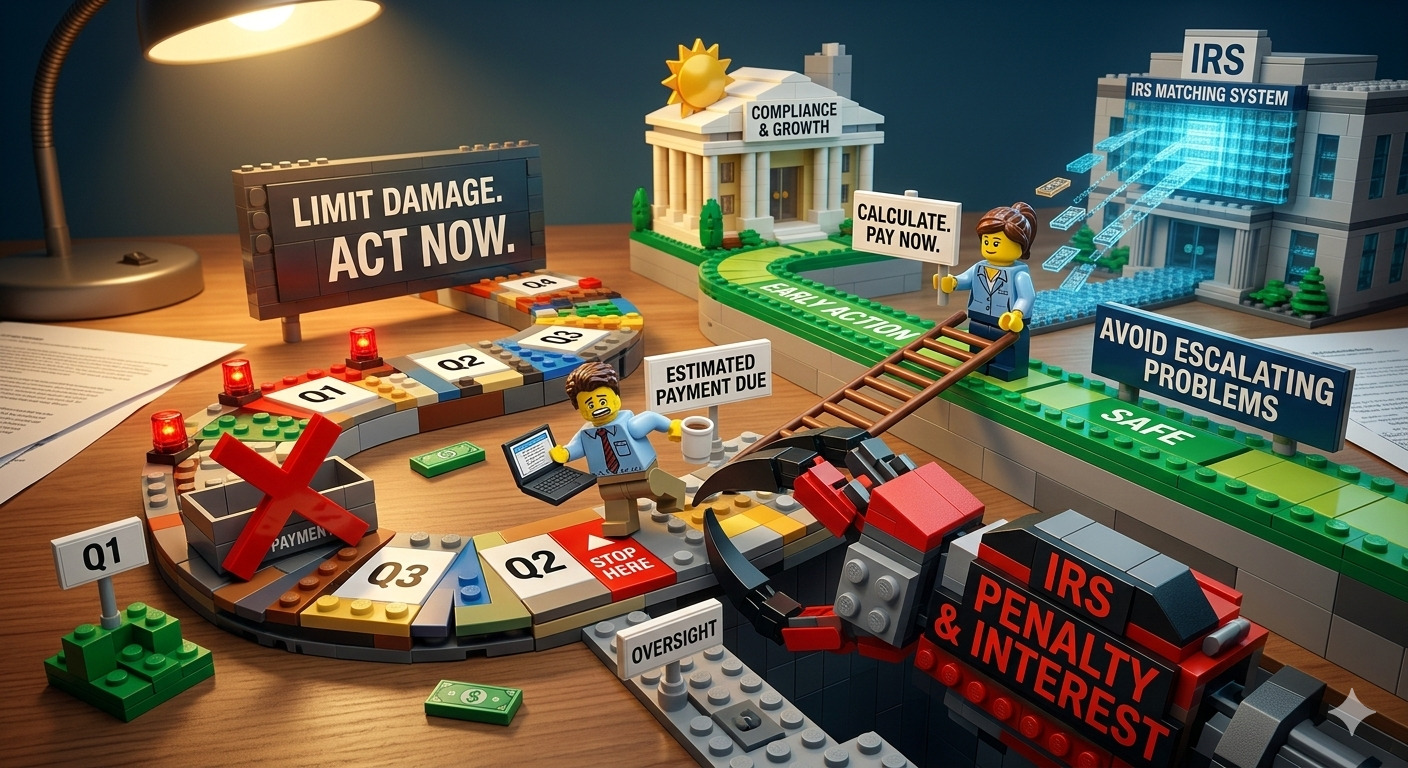
If you’re self-employed and just realized you missed an estimated tax payment, take a breath.
You’re not the first business owner this has happened to—and you won’t be the last.
At Tax Workout Group, we regularly speak with freelancers, consultants, contractors, and small business owners who meant to send in their quarterly payment… but life, cash flow, or simple oversight got in the way.
The key is not perfection. The key is what you do next.
This guide explains what happens when you miss an estimated tax payment, how penalties work, and the steps you should take immediately to limit damage and avoid escalating IRS problems.
Why Estimated Tax Payments Matter for the Self-Employed
If you’re self-employed, the IRS doesn’t withhold taxes from your income the way it does for W-2 employees. That means you’re generally required to make quarterly estimated tax payments throughout the year.
These payments typically cover:
- Federal income tax
- Self-employment tax (Social Security and Medicare)
- In some cases, state taxes
When you miss a payment, the IRS treats it as an underpayment for that quarter, even if you plan to “catch up later.”
And that’s where penalties begin.
What Happens If You Miss an Estimated Payment?
Missing a quarterly payment does not trigger an immediate audit. It does not mean criminal trouble. But it can trigger penalties and interest.
Here’s what typically happens:
1. Underpayment Penalty Accrues
The IRS may assess an underpayment penalty based on:
- How much you should have paid
- How long the payment was late
- Applicable interest rates
Even if you pay the full amount at year-end, you can still owe a penalty for paying late during the year.
2. Interest Begins Running
Interest accrues from the due date of the missed payment until it’s paid.
This is why waiting until April to fix the issue often costs more than addressing it immediately.
3. Cash Flow Pressure Increases
If one quarterly payment was missed due to tight cash flow, the next may be harder to make. That’s how small gaps turn into large balances.
The good news is that early action can significantly reduce the damage.
Step One: Don’t Ignore It
The worst move after missing a payment is pretending it didn’t happen.
Many business owners tell themselves:
- “I’ll make it up next quarter.”
- “I’ll deal with it at tax time.”
- “Maybe it won’t matter.”
Unfortunately, it usually does.
Instead, shift from avoidance to action.
Step Two: Calculate What You Owe Now
Before panic sets in, get clarity.
Determine:
- What you were supposed to pay
- What you actually paid
- The shortfall amount
If you’re unsure how to calculate this correctly, that’s a sign to pause and get professional input. Guessing often leads to compounding mistakes.
Once you know the number, the next decision is how quickly you can close the gap.
Step Three: Pay What You Can—As Soon As You Can
Even partial payments help.
The IRS calculates penalties based on unpaid balances over time. Reducing the balance sooner can limit how much you ultimately owe.
If you can make the missed payment now, do so.
If you don’t, that’s when strategy matters.
When Missing One Payment Signals a Bigger Problem
For many self-employed individuals, one missed estimated payment is a warning sign of a larger issue:
- Income fluctuates unpredictably
- Expenses were higher than expected
- You’re not setting aside enough for taxes
- You’re behind on bookkeeping
- You’re juggling multiple years of tax debt
If this sounds familiar, the issue may not be a single missed payment—it may be a compliance structure problem.
At that point, waiting for the IRS to respond is not a strategy.
What If You Can’t Catch Up?
If cash flow won’t allow you to catch up on missed estimated payments, here’s what matters most:
- File your tax return on time. Filing late creates additional penalties.
- Do not ignore IRS notices. Early notices are easier to resolve than enforced collections.
- Get advice before the balances snowball.
If missed estimated payments lead to a year-end balance you cannot pay, you may face:
- Failure-to-pay penalties
- Interest accumulation
- Federal tax liens
- Bank levies or wage garnishments in more serious cases
Those outcomes are preventable—but only if addressed early.
Common Mistakes Self-Employed Taxpayers Make After Missing a Payment
We frequently see business owners make these well-intentioned but risky moves:
- Using personal credit cards to pay taxes without a plan
- Borrowing informally without considering repayment pressure
- Filing late because they’re embarrassed
- Ignoring IRS mail due to stress
None of these solves the root problem.
The better approach is clarity, structure, and proactive compliance.
How to Prevent This From Happening Again
Once you’ve addressed the immediate issue, it’s worth setting up a system:
- Open a separate “tax savings” account
- Transfer a fixed percentage of income weekly
- Review estimated payments quarterly with a professional
- Keep bookkeeping current
Estimated taxes are predictable—even if income fluctuates. With proper planning, they don’t have to feel like emergencies.
When It’s Time to Schedule a Consultation
Missing one payment doesn’t mean you need legal intervention. But you should strongly consider speaking with a tax professional if:
- You’ve missed multiple estimated payments
- You’re unsure how much you owe
- You’re behind on filing
- You already owe back taxes
- You’ve received IRS notices
- You’re worried about liens or levies
At Tax Workout Group, we help self-employed individuals move from reactive to proactive. Early intervention is almost always less expensive—and less stressful—than waiting for enforced collection action.
Final Thought: Act Before the IRS Does
A missed estimated tax payment is not a catastrophe.
But ignoring it can turn it into one.
If you’ve missed a quarterly payment, are unsure about your estimated tax obligations, or feel like your tax situation is starting to spiral, now is the time to act.
Don’t Let One Missed Payment Turn Into an IRS Problem.
Schedule a free, confidential consultation with Tax Workout Group today.
The sooner you address it, the more options you typically have—and the less it ultimately costs you in penalties, interest, and stress.

